Sikha and Hinduism
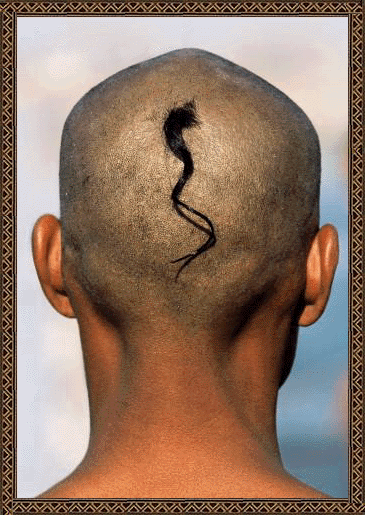 The sikha, which the Tamils call "Kudumi", is a Sanskrit word that refers to a long tuft, or lock of hair left on top or on the back of the shaven head of a Hindu male.
What Exactly a Sikha is?
 There is, however, no standard definition as how and what a "sikha" should be or look like. For instance, in Tamil Nadu, the Southern part of India where the majority of Tamils live, "sikha" is known by two common terms "Pin Kudumi" (=knotted lock of hair on the crown of the head and the rest of the hair shaved off) and "Mun-Kudumi" (=the hair is grown long in the front and knotted to the forehead).
Mun Kudumi was popular among earlier Brahmin Dikshitar, Namboothiri and Chozhiya. In point of fact, the Nairs (in Kerala), who are not Brahmin, at one time sported this style.
Is it in the Scriptures?
 It is widely believed that according to the Hindu tradition, every male Hindu is required to wear a sikha. There are, however, no authentic scriptural injunctions that dictate that this must be observed. Erudite Hindu pundits and Shastris, when pressed to cite scriptural evidence to bear out this belief, are unable to give anything on the point from the Vedas. Often, they rely on the allusion to it found in the Manu Smriti (ii : 27) ---
 "By oblations to fire during the mother's pregnancy, by holy rites on the birth of the child, by the tonsure of his head with a lock of hair left on it, by the ligation of the sacrificial cord are the birth taints of the three classes wholly removed."
God Pulls One Up From Maya?
 But what about the myth that the Hare Krsnas have propagated that "the sikha" allows God to pull one to heaven, or from this material world of Maya?
This myth has no backing either in the Srimad Bhagavatam nor in any puranic literature. It is their founder archarya's instructions to His followers.
This belief, i.e., the sikha "allows God to easily pull one to paradise" may, in fact, be an Islamic (or at least an Arabian) superstition:
Islamic Concoctions
Sir Thomas Herbert, 1st Baronet (1606–1682) described a similar hairstyle worn by Persians in his book 'Travels in Persia':
- "The Persians allow no part of their body hair except the upper lip, which they wear long and thick and turning downwards; as also a lock upon the crown of the head, by which they are made to believe their Prophet will at Resurrection lift them into paradise. Elsewhere their head is shaven or made incapable of hair by the oil dowae (daway) being thrice anointed. This had been made the mode of the Oriental people since the promulgation of the alcoran (Al Quran), introduced and first imposed by the Arabians."
- "All Arabs, men and boys, have their heads shaved, leaving only a scalp lock, said by some to be left in imitation of the Prophet, who wore his own thus; and by others said to be for the convenience of the angel who will pull them out of the graves when the day of rising shall come."
Ayurveda
 Sushruta, the author of Sushruta Samhita, an Ayurvedic literature, has been purported to have encouraged the sporting a "sikha" to protect the head from injuries. But the "sikha" that has been referred to therein has nothing to do with the types that the Hare Krsnas keep.
Comments
Post a Comment